
Overview
Pécs is a city of considerable historical depth in southern Hungary, designated a UNESCO World Heritage site for its rich layers of cultural and architectural heritage. With a population of around 145,000, it strikes a balance between urban vitality and manageable scale, making it accessible for exploration on foot yet substantial enough to sustain museums, theatres and cultural institutions.
The city's character reflects centuries of diverse influence. Medieval fortifications, Ottoman-era religious buildings, Baroque and Renaissance structures, and industrial heritage from the modern era coexist across the townscape. This layering makes Pécs rewarding for those interested in how cities accumulate identity over time, rather than presenting a single polished historical moment.
Key facts
| Country | Hungary |
|---|---|
| Population | 145,347 |
| Timezone | Europe/Budapest |
| Nearest airport | Pécs-Pogány International Airport (PEV), 10 km |
| Currency | HUF |
Things to do in Pécs
The Early Christian Necropolis of Pécs represents one of the city's most significant archaeological assets and holds UNESCO recognition. This site preserves burial chambers and remains from the early Christian period, offering tangible evidence of the city's ancient spiritual and social structures. It forms part of what makes Pécs's claim to World Heritage status compelling—the survival of material culture across millennia.
Pécs Cathedral stands as a major religious landmark, reflecting the city's ecclesiastical importance across different historical periods. Its architecture and presence anchor the central urban landscape, and it remains a focal point for understanding how faith has shaped the city's development.
The Mosque of Pasha Qasim is a striking reminder of the Ottoman era, when the region came under different political control. This building exemplifies how Pécs absorbed diverse architectural traditions and religious uses, a characteristic that distinguishes it from many other Central European cities. The Yakovalı Hasan Paşa Mosque operates as a museum, allowing visitors to understand Ottoman period structures within their historical context rather than simply as relics.
The Klimo Library holds UNESCO designation and represents the intellectual life of the city. Libraries of this calibre speak to the presence of educated communities and scholarly traditions that extended beyond the immediate present, suggesting how Pécs functioned as a centre of learning.
Two theatres—the National Theatre of Pécs and the Croat Theatre of Pécs—indicate an active performing arts culture. The presence of both a national theatre and a theatre dedicated to Croat performance reflects the ethnic and cultural complexity of the region's history and present composition.
Magasház is a landmark structure within the city, contributing to the architectural variety that characterises Pécs's streetscape. The city's built environment rewards walking and observation, with individual buildings revealing different periods and approaches to urban design.
For those interested in industrial heritage and local production, the Pécs Brewery and Zsolnay represent different scales of manufacturing history. These sites connect the city to its economic past and the goods it produced for wider markets. The Zsolnay enterprise, in particular, was historically significant to the region's industrial identity.
Széchenyi Square functions as a key public space, typical of Central European city centres as places for social gathering, commerce, and civic life. Squares of this type often contain layered histories visible in their architecture and street-level activity.
The Mecseki narrow gauge railway provides access to higher terrain and represents a particular kind of transport heritage. Railways of this type, built to navigate challenging topography, are increasingly rare and offer both practical movement through the landscape and a glimpse into how earlier generations engineered solutions to geographical constraints.
Misina and Tubes are mountains within reach of the city, along with Jakab-hegy, which hosts the Celtic Castle on Jakob's Hill—an archaeological site indicating pre-medieval habitation and settlement patterns in the region. The Pécs TV Tower and views from elevated positions provide geographic orientation and broader perspectives on the city's setting within its surrounding territory.
Lauber Dezső Sports Hall represents modern sporting infrastructure, part of the contemporary city's functioning rather than its heritage dimension, but indicative of what the city offers to residents and visitors beyond historical tourism.


Experiences you can book in Pécs
 Sailing at Lake BalatonFree cancellationInstant confirmation
About this experience
In the middle part of the lake having a cruise with a Scandinavian fast sailboat as a private trip, you will feel the most unique peace on a little landlocked sea - Lake Balaton is the biggest lake in Europe, 75 km wide and 3-4 meter deep. If the weather allows, we can throw an…
from £304.94Book on Viator →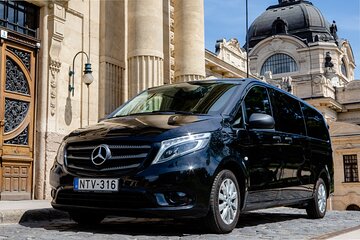 Pécs - Budapest TransferFree cancellationInstant confirmation
About this experience
Our Pécs - Budapest Transfers are perfect for those who love it when things go according to plan. We offer an easy and affordable way of travelling that’s available round the clock. All you have to do is kick back and enjoy your vacation.
from £149.59Book on Viator →
Experiences are sold and operated by Viator and its local suppliers. Head Your Way is an affiliate: we may earn a commission, but your booking, payment, cancellations, refunds and any insurance are handled entirely by Viator under their terms. Head Your Way is not the seller and is not a party to your booking. Prices and availability shown are from Viator and can change — confirm full details on Viator before booking.
Neighbourhoods and areas
Belváros is the central district, containing the core historic fabric and major landmarks. This is where the city's medieval and later street patterns are most evident, and where most cultural institutions and public spaces cluster.
The Zsolnay Cultural Quarter represents a distinctive area with historical industrial heritage at its core, transformed into a cultural zone. This neighbourhood demonstrates how former manufacturing sites can be repurposed while maintaining their historical identity. It's a relatively recent approach to urban renewal, reflecting contemporary attitudes to industrial archaeology and creative reuse.
Uránváros is a residential neighbourhood, typical of urban expansion in the modern era. Including such areas in any city map reflects how Pécs functions as a lived-in place rather than purely a heritage destination—the majority of residents live in these districts, not in the museum-piece centre.
Pécs District, Balokány, Üszögpuszta, Megyer, Patacs and Tettye complete the administrative and geographic makeup of the city, forming its suburban and outer reaches. These neighbourhoods define Pécs as an extended urban territory rather than a compact historic core.

Getting there
Pécs-Pogány International Airport lies just under 10 kilometres from the city centre, making it the most straightforward air access point. From here, ground transport into the city is straightforward.
For those flying into the wider region, Osijek Airport is approximately 82 kilometres away, and Hévíz–Balaton Airport, serving the Lake Balaton area, sits roughly 106 kilometres north. Both offer alternative entry points depending on flight availability and routing.
The city is situated within Pécs District, in the administrative region, facilitating connections to surrounding settlements and regional transport networks. Hungary's road and rail infrastructure connects Pécs to Budapest and other major centres, though journey times from the capital are substantial.
Find flights to Pécs →arrives PEV (9.8 km away)

Day trips from Pécs
The surrounding region contains several settlements accessible as day trips. Dombóvár lies only 34 kilometres away, making it feasible for a brief excursion. Kaposvár and Szekszárd are both within 50 kilometres, positioning them as half-day possibilities.
Further afield, Baja is approximately 57 kilometres distant, whilst Siófok, on Lake Balaton, sits around 93 kilometres north. Keszthely, also Balaton-adjacent, is comparable in distance at roughly 108 kilometres, as is Tapolca. Veszprém, another substantial city, lies approximately 116 kilometres away.
Danube-Drava National Park, in the wider area surrounding Pécs, offers natural landscape exploration for those seeking outdoor experience beyond the urban centre. This park represents the regional ecology and provides context for understanding Pécs's geographic setting within a larger environmental system.


When to visit
Pécs's climate and seasonal character are relevant to planning a visit, though specific temperature and precipitation data for the city are not available in current records. Visitors should research seasonal weather patterns for southern Hungary before booking, as this will influence both comfort levels and the feasibility of exploring outdoor attractions like the surrounding mountains and open-air sites.
The city functions year-round as a cultural and educational centre, with theatres and museums operating throughout the year, making it viable to visit regardless of season. Those particularly interested in walking the city, visiting archaeological sites, or exploring the higher terrain around Misina, Tubes and Jakab-hegy may prefer seasons when outdoor conditions are most comfortable.

Essential information
Pécs operates in the Central European timezone (Europe/Budapest) and uses Hungarian forints (HUF) as currency. Hungarian is the primary language spoken; visitors should arrange translation assistance or language tools in advance if needed.
The official city website (pecs.hu) may provide additional information for planning purposes, including details on current exhibitions, performance schedules, and facilities. The city's UNESCO World Heritage designation means certain sites and districts receive protection and management, which may affect access or visiting conditions.
With a population of 145,000, Pécs is substantial enough to have reliable modern amenities—accommodation, dining, transport—whilst remaining compact enough that the central areas are navigable without specialist guidance. The 16,278 square kilometre administrative area encompasses both the city proper and surrounding territory, so distances to some attractions should be checked before setting out.

Journeys through here
Where to stay in Pécs
Hotels are booked on Booking.com (a third party, off this page). You book and pay them directly — Head Your Way is not the seller.
Getting around Pécs
Affiliate links — we may earn a commission, never at extra cost to you.
Common questions
- What makes Pécs a UNESCO World Heritage site?
- Pécs holds UNESCO World Heritage designation based on its historical and cultural significance, particularly the Early Christian Necropolis, which preserves substantial archaeological material from the early Christian period. The Klimo Library also carries UNESCO recognition. Together with the city's broader layering of medieval, Renaissance, Baroque and Ottoman-era structures, these elements combine to form a heritage landscape of considerable depth and importance.
- What evidence of Ottoman occupation survives in Pécs?
- The Mosque of Pasha Qasim and the Yakovalı Hasan Paşa Mosque (now operating as a museum) are direct architectural legacies from the Ottoman period when the region was under Ottoman control. These buildings demonstrate how Pécs absorbed and retained structures from different political and religious traditions, distinguishing it from many other Central European cities with less visible Ottoman heritage.
- Are there outdoor activities available near Pécs?
- Yes. Misina, Tubes and Jakab-hegy are mountains accessible from the city, with Jakab-hegy hosting the Celtic Castle on Jakob's Hill, an archaeological site. The Mecseki narrow gauge railway provides access to higher terrain. Danube-Drava National Park in the wider area offers natural landscape exploration. These options provide alternatives to urban sightseeing for those seeking outdoor experience.
- How large is Pécs and how walkable is it?
- Pécs has a population of approximately 145,000, making it a substantial city rather than a small town. The central districts, particularly Belváros, are walkable for exploring historic sites and major landmarks. However, the full administrative area spans 16,278 square kilometres, so some attractions require transport. Research individual sites before visiting to determine travel time from the centre.
On the map
Keep exploring
More places in Hungary
Similar destinations
Plan the wider trip
Sources & method
- GeoNames — population · retrieved 2026-08-14
- OurAirports (derived) — nearestAirports · retrieved 2026-08-14
- Imagery — commons
Data compiled 2026-08-14 · editorial checks: passed. See our methodology for how Head Your Way sources and reviews travel data.