
Overview
Madrid is Spain's capital and largest city, home to nearly 3.3 million people across a sprawling metropolitan area. The city holds UNESCO World Heritage status and serves as the country's cultural, political and economic heart. Built at an elevation where continental air masses collide, Madrid experiences distinct seasons—hot, dry summers and cold winters—making timing your visit genuinely consequential.
The city's character emerges from centuries of layered history, from medieval foundations through Renaissance expansion, Baroque embellishment, and modern development. Today it functions as a vibrant centre for theatre, visual art, architecture and Spanish intellectual life, with neighbourhoods ranging from historic central districts to residential suburbs that sprawl across 604 square kilometres.
Key facts
| Country | Spain |
|---|---|
| Population | 3.26 million |
| Timezone | Europe/Madrid |
| Nearest airport | Adolfo Suárez Madrid–Barajas Airport (MAD), 14 km |
| Currency | EUR |
History and context
Madrid's origins lie in the medieval period, when it emerged as a modest settlement in the Iberian peninsula. The city's significance grew during the Renaissance, when Spain's expanding power brought renewed investment and cultural ambition. The Baroque era saw Madrid transformed into a grand capital, with new palaces, convents and churches rising across the urban fabric.
This layering of epochs has left visible traces throughout the city. Medieval foundations support Renaissance facades; Baroque churches stand alongside modern structures. The Convento de las Trinitarias Descalzas and Parroquia de San Ginés preserve elements of the city's religious past, while civic and cultural institutions reflect centuries of patronage and intellectual development.
Madrid became a UNESCO World Heritage site in recognition of this accumulated architectural and cultural significance. The designation encompasses not merely individual monuments but the broader urban fabric—the way centuries of building, planning and habitation have shaped the city's character and streetscape.


Things to do
Madrid's theatrical heritage remains remarkably vivid. Six theatres within the city proper testify to the enduring importance of live performance: Teatro Español, Teatro Reina Victoria, Teatro Alcázar, Teatro de la Comedia, Teatro Albéniz and Teatro de la Zarzuela. These venues range across architectural styles and dramatic traditions, from classical Spanish theatre to contemporary work. Theatre-goers will find productions running throughout the year, with programming that reflects both canonical works and new writing.
The city's museums offer substantial collections across multiple disciplines. Museo Thyssen-Bornemisza ranks among Europe's important art institutions, while Casa Museo Lope de Vega preserves the home of the Renaissance dramatist, offering insight into early modern Madrid domestic life. Both merit several hours; neither is a quick stop. Palacio Gaviria functions as a landmark palace, representing the architectural grandeur that accumulated wealth could command.
Religious architecture punctuates the city substantially. Beyond the Convento de las Trinitarias Descalzas and Parroquia de San Ginés, Parroquia de Santa Cruz marks another point in the network of parish churches that served Madrid's expanding population. These buildings reflect the city's Catholic heritage and, in their physical presence and decoration, offer windows onto different periods of the city's religious life.
Several notable landmarks lie just beyond the strict city boundary but remain accessible within a short journey. Palacio Real stands as one of Europe's largest palace complexes, functioning as an official royal residence. The Real Basílica de San Francisco el Grande represents significant Baroque religious architecture. Templo de Debod offers an unexpected presence—an ancient Egyptian temple relocated to Madrid, now positioned in a park setting. These sites, while technically outside Madrid proper, form essential parts of any comprehensive visit to the capital.
The city contains several museums and cultural institutions housed in significant buildings. Palacio de Liria functions as a museum, while Círculo de Bellas Artes represents the institutional patronage of artistic practice. These venues combine architectural interest with substantive cultural programming. Centro Sefarad-Israel focuses on Sephardic Jewish heritage and history, occupying space within Madrid's layered cultural landscape. Real Academia Española, Real Academia Nacional de Medicina de España and other learned institutions mark Madrid's role as a centre of Spanish intellectual life, though many function primarily as working organisations rather than public museums.


Experiences you can book in Madrid
 Madrid: Royal Palace Guided Tour with Skip the Line TicketFree cancellationInstant confirmation
About this experience
Ready to dive into the opulent world of Madrid's Royal Palace? I'm your guide for this incredible journey. The guide will be at the specified location, ready and waiting for you. From there, we'll stroll through Plaza de Oriente, soaking in the atmosphere before skipping the…
from £30.58Book on Viator → Three Cities in One Day: Segovia, Avila and Toledo from MadridFree cancellationInstant confirmation
About this experience
Join this 11-hour trip from Madrid that takes you to three cities in just one day. Come and discover three cities named World Heritage sites by UNESCO, and just a short distance from Madrid. Join us and our official professional guide on this guided tour, where we will show you…
from £70.77Book on Viator → Tour Welcome Madrid in Eco Tuk Tuk Private with Local GuideFree cancellationInstant confirmation
About this experience
Eco Tuk Tuk offers you a 120-minute drive through Madrid. A contact with the capital of Spain where you can see the most relevant areas of the city and discover its secrets. It’s a perfect way to get a broad idea of everything you can enjoy in the city on your travel days.
from £17.21Book on Viator → Madrid Tapas & Wine Tasting Food Tour – Small Group Local BarsFree cancellationInstant confirmation
About this experience
Discover the authentic flavors of Madrid on this 3-hour Small-Group Tapas & Wine Food Tour through the historic city center. Explore the famous Madrid of the Habsburgs while visiting 4 traditional tapas bars loved by locals, far from the typical tourist traps. Taste 12 carefully…
from £69.03Book on Viator → From Madrid: Toledo & Segovia Day Tour with Lunch & TicketsFree cancellationInstant confirmation
About this experience
Discover why this tour won the TRIPADVISOR TRAVELERS' CHOICE AWARD 2025! The story of Medieval Spain is a blend of Roman influence, Muslim rule, Jewish culture, and Christian rise, and there may be no better examples of this history than Toledo and Segovia.. Immerse yourself…
from £33.16Book on Viator →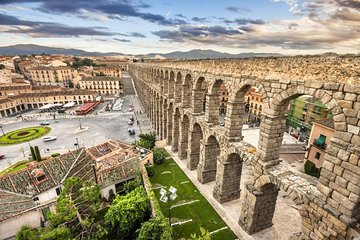 Avila & Segovia Tour with Tickets to Monuments from MadridFree cancellationInstant confirmation
About this experience
The Best Excursion to Ávila and Segovia from Madrid The only tour to Ávila and Segovia rated 5 stars and certified for excellence. Enjoy a unique excursion to discover two of the oldest and most iconic cities in Spain on a comfortable full-day trip from Madrid. Transportation…
from £69.03Book on Viator →
Experiences are sold and operated by Viator and its local suppliers. Head Your Way is an affiliate: we may earn a commission, but your booking, payment, cancellations, refunds and any insurance are handled entirely by Viator under their terms. Head Your Way is not the seller and is not a party to your booking. Prices and availability shown are from Viator and can change — confirm full details on Viator before booking.
Neighbourhoods to explore
Madrid comprises numerous neighbourhoods, each with distinct character and function within the larger city. Understanding them provides practical orientation and reveals how the city developed beyond any single historic core.
Buenavista lies within Madrid proper and merits exploration as a residential neighbourhood with its own local character. Los Ángeles represents another neighbourhood within the city boundary, though the facts provide limited specific detail about its attractions or particular character. Both function as residential areas within Madrid's broader metropolitan composition.
Comillas and La Chopera appear on the official neighbourhood register and offer further residential areas for exploration, though the provided information focuses more heavily on the city's central attractions and theatrical institutions. These neighbourhoods form part of Madrid's genuine urban fabric—places where people live and move through daily routines, rather than destinations specifically developed for visitors.
Campamento and Cuatro Vientos represent further neighbourhood divisions within Madrid, each contributing to the city's sprawling metropolitan area. Las Águilas similarly marks another recognised neighbourhood. These varied districts underscore Madrid's scale—a city of 3.2 million people cannot be comprehended as a single centre but rather as an agglomeration of distinct zones, each with its own logic and social composition.
Villaverde Alto and Villaverde form a district with both historical and contemporary significance, the latter containing Casco Histórico de Villaverde (the historic core of this area). These neighbourhoods exemplify how Madrid's expansion incorporated previously separate settlements into its municipal boundaries, creating layered urban zones where older communities persist within the larger metropolitan structure.

When to visit
Madrid's climate divides the year into two distinct regimes, with profound implications for travel planning. Summer months—June, July, August and early September—bring the best weather for visiting: long daylight hours, warm days and minimal rainfall. July reaches average highs of 32.9°C with very dry conditions, while June, August and September offer comparable warmth with slightly lower temperatures. These months see peak tourist presence but reward visitors with reliable sunshine and the ability to spend extended time outdoors.
May rounds out the warm-season options, offering pleasant conditions before the hottest months arrive. Early September provides similar advantages to June, making the May-to-September window the preferred visiting season. The warmest months can feel oppressive if you are uncomfortable in high heat; conversely, they offer the season's most reliable weather.
Winter in Madrid brings cold temperatures but generally clear skies. January, the coolest month, registers average lows of 1.3°C and highs around 8°C. December and February offer similar conditions. While uncomfortable for extended outdoor exploration without proper clothing, winter visits bring fewer crowds and reveal the city's character beyond its peak-season tourist infrastructure. Rain occurs but remains moderate except during November, the wettest month, which sees substantially increased precipitation.
November represents the least attractive visiting month due to elevated rainfall combined with cooling temperatures. October and April provide transitional seasons with moderate temperatures and variable rainfall—acceptable visiting periods but without the weather reliability of May through September. If flexibility exists in your travel dates, the five-month window from May through September offers the strongest combination of reliable weather and comfortable daytime conditions.

Getting there
Adolfo Suárez Madrid–Barajas Airport (MAD) serves as the primary international gateway, located 13.9 kilometres from the city centre. Most visitors arrive via air, with the airport handling substantial international and domestic traffic. Ground transportation from the airport into central Madrid provides multiple options; the specific arrangements depend on your accommodation and travel preferences.
Ground-based access to Madrid remains viable for visitors coming from other European cities, though the city's inland location limits certain journey options. Rail connections link Madrid to numerous Spanish and international destinations, though the facts provided do not specify the details of these services.
Flights from £33 to Madrid →from London · arrives MAD (13.9 km away) · recently-found fare — price & availability change

Getting around
Moving through a city of 3.2 million people across 604 square kilometres requires reliable transport infrastructure. The facts indicate the existence of Metro Ligero Line 2, a light rail service providing rapid transit across certain sections of the metropolitan area. Multiple underground interchanges—Aluche Interchange among them—facilitate connections between different transport lines.
Various neighbourhoods and districts connect via transport nodes that remain partially opaque in the provided information. José Isbert Station marks one transit point within the broader network. The scale of Madrid necessitates using mechanical transport rather than attempting to walk the entire city; understanding the public transit system becomes essential for efficient navigation.
Beyond the specific transit points mentioned, the facts do not provide comprehensive details about Madrid's public transport system as a whole. Visitors should expect a city-scale transportation network with multiple options, but detailed routing and service information would require consultation of current Madrid transport authority resources.

Day trips from Madrid
Toledo lies 67.8 kilometres from Madrid and functions as the most substantial nearby destination, significant enough to merit a full day's excursion. The city holds its own historical importance and differs substantially in character from the Spanish capital. As a separate destination worthy of extended exploration, Toledo typically consumes a full day and remains one of Spain's most visited cities beyond Madrid itself.
Alcalá de Henares sits considerably closer at 29.9 kilometres and provides a shorter option for those with limited time. This city offers distinct attractions and serves as an alternative to intensive central Madrid tourism for visitors seeking to experience the surrounding region.
Closer destinations prove viable for shorter excursions. Leganés, Getafe, Móstoles, Fuenlabrada, Torrejón de Ardoz and Alcorcón all lie within 20 kilometres of central Madrid—distances manageable within a few hours' round trip. These towns form part of Madrid's metropolitan area rather than standing as independent tourist destinations in their own right. They suit visitors seeking to explore the broader urban region or those with specific interest in suburban Madrid rather than the celebrated central sites.
The accessibility of these surrounding destinations reflects Madrid's role as the hub of a substantial metropolitan region. Whether any of these closer towns merits a specific visit depends on individual interests; for most tourists, Toledo provides the most compelling day-trip option, whilst the intermediate-distance towns of Alcalá de Henares and Getafe offer secondary alternatives if Toledo timing doesn't align with your schedule.

Good to know
Madrid operates under the Europe/Madrid timezone and uses the Euro (EUR) as currency. Spanish serves as the official language throughout the city; English prevalence varies considerably depending on location and context. In central tourist areas and established institutions, English speakers will encounter reasonable accommodation. In residential neighbourhoods and smaller establishments, Spanish language ability becomes more valuable.
The city's UNESCO World Heritage status reflects its accumulated architectural and cultural significance but does not necessarily mean specific individual attractions carry UNESCO designation themselves. Within the attractions listed for Madrid proper, neither Museo Thyssen-Bornemisza, Casa Museo Lope de Vega nor any of the individual theatres or churches holds separate UNESCO recognition, though they contribute to the overall designation of Madrid as a heritage site.
Summer heat in July reaches sustained levels—average highs of 32.9°C—that should inform packing decisions and daily scheduling. Visitors uncomfortable with prolonged heat exposure should schedule visits outside this month, whilst those visiting during this period should plan substantial indoor time during peak afternoon hours. Winter requires appropriate cold-weather clothing, particularly for early morning or evening outdoor activities, though daytime temperatures permit normal movement.
Madrid's scale—a city of 3.2 million people sprawling across 604 square kilometres—means that any visit attempting to see 'everything' will result in insufficient time at individual sites. Prioritising attractions based on personal interests yields better experiences than attempting comprehensive coverage. The numerous theatres, churches and palaces cannot realistically be visited during a brief trip; focus emerges as essential.
Museums and cultural institutions
Museo Thyssen-Bornemisza represents the most substantial museum within Madrid proper according to the provided attractions list. This collection warrants several hours of concentrated viewing; it should not be rushed. The museum occupies significant space within Madrid's cultural landscape and serves as a primary draw for art-focused visitors.
Casa Museo Lope de Vega offers a fundamentally different museum experience—a preserved domestic setting rather than a formal collection gallery. The house illuminates how a significant literary figure lived during the Renaissance period, providing intimate context for understanding early modern Madrid. This museum suits visitors interested in Spanish literature, domestic history or the lived experience of the period.
Palacio de Liria functions as a museum housed within a significant historic palace, combining architectural interest with curatorial programming. The Palacio del Marqués de Salamanca, now functioning as the Fundación BBVA, represents another historic building repurposed for cultural institutional use. These venues blend architectural experience with exhibition content.
Templo de Debod offers perhaps Madrid's most unusual cultural institution—an ancient Egyptian temple relocated to Spain and now displayed as a museum. The incongruity of an Egyptian monument in Madrid reflects the collecting impulses of European powers and now provides an unexpected cultural experience within the capital. Its positioning in a park setting creates a distinctive environment for encountering this ancient structure.
Real Academia Española, Real Academia Nacional de Medicina de España and similar learned institutions shape Madrid's intellectual character even though they function primarily as working organisations rather than tourist-accessible museums. Their existence underscores Madrid's role as a centre of Spanish scholarship and cultural authority. Some offer limited public access or special viewing arrangements; others remain private professional organisations. Centro Sefarad-Israel focuses specifically on Sephardic Jewish heritage, occupying a specialized curatorial role within Madrid's cultural institutions.
Palaces and religious architecture
Madrid's palace architecture reflects centuries of accumulating wealth and power. Palacio Gaviria stands within the city proper as a landmark palace, whilst nearby structures like Palacio Real, the enormous official royal residence, lie just outside Madrid's strict boundaries. Real Monasterio de la Encarnación and Real Basílica de San Francisco el Grande represent the religious architectural counterpart to secular palaces, demonstrating the equal grandeur commanded by ecclesiastical institutions during the Baroque era.
The city contains numerous parish churches reflecting its medieval and early modern growth. Parroquia de San Ginés, Parroquia de Santa Cruz and the nearby Iglesia de San Martín mark points in this network of local religious provision. These buildings typically show multiple periods of construction and modification, their physical fabrics recording the changing tastes and resources of different eras. Basílica Pontificia de San Miguel and Iglesia de las Calatravas (Concepción Real de Calatrava) represent more elaborate religious architecture, whilst Real Oratorio del Caballero de Gracia rounds out the survey of Madrid's numerous ecclesiastical buildings.
Monasterio de las Descalzas Reales, technically outside the strict Madrid boundary but immediately accessible, represents an important convent complex with both architectural and historical significance. The Convento de las Trinitarias Descalzas, within Madrid proper, similarly reflects the city's substantial monastic heritage.
These palaces and churches should not be approached as isolated monuments but as components of Madrid's evolving urban fabric. Their positioning, size and decoration relative to surrounding structures illustrates how different populations—royal, noble, ecclesiastical, common—asserted presence and authority through architecture. Walking through central Madrid naturally encounters these buildings; understanding their historical and cultural context deepens the experience beyond simple aesthetic appreciation.
Journeys through here
Notable people from Madrid
Born in Madrid
- Lope de Vegawriter
- Felipe VI of Spain
- Pedro Calderón de la Barcawriter
- Pedro Sánchezpolitician
- Jacinto Benaventefilm director, journalist, politician
- Enrique Iglesiasmusician, composer, actor
- José Echegarayscientist, politician, writer
- José Ortega y Gassetpolitician, writer
All 1127 notable people born in Madrid →
Died in Madrid
- Miguel de Cervanteswriter
- Diego Velázquezpainter
- Francisco Francoactor, politician
- Lope de Vegawriter
- Pedro Calderón de la Barcawriter
- Miguel Ángel Asturiasjournalist, politician, writer
All 1046 notable people who died in Madrid →
People with a birthplace or place of death in Madrid (Wikidata, notability floor 10 Wikipedia editions). Names link to English Wikipedia (CC BY-SA).
Where to stay in Madrid
Hotels are booked on Booking.com (a third party, off this page). You book and pay them directly — Head Your Way is not the seller.
Getting around Madrid
Affiliate links — we may earn a commission, never at extra cost to you.
Common questions
- Is Madrid a UNESCO World Heritage site?
- Yes, Madrid holds UNESCO World Heritage status. The designation reflects the city's accumulated architectural and cultural significance across multiple historical periods, though this applies to Madrid as a whole rather than to individual specific attractions within it.
- What is the best time to visit Madrid?
- May through September offers the most reliable weather, with June, July, August and early September providing warm, dry conditions ideal for outdoor exploration. July reaches the warmest temperatures (average highs of 32.9°C). If heat is uncomfortable, May and September provide comparable daylight with slightly lower temperatures. Winter (December–February) brings cold conditions but fewer crowds and generally clear skies, though November is notably wet and less attractive.
- How far is the airport from Madrid city centre?
- Adolfo Suárez Madrid–Barajas Airport (MAD) is located 13.9 kilometres from the city centre, making it readily accessible by ground transport.
- What language is spoken in Madrid?
- Spanish is the official language. English is reasonably available in central tourist areas and established institutions but less common in residential neighbourhoods and smaller establishments. Basic Spanish language ability proves valuable for a more independent visit.
- Are there day trips available from Madrid?
- Yes. Toledo (67.8 km away) represents the most substantial day-trip destination, significant enough to merit a full day's exploration. Alcalá de Henares lies 29.9 kilometres away and provides a shorter alternative. Numerous towns within 20 kilometres—including Leganés, Getafe, Móstoles, Fuenlabrada, Torrejón de Ardoz and Alcorcón—form part of Madrid's metropolitan region and suit shorter excursions.
- What currency is used in Madrid?
- The Euro (EUR) is the currency used throughout Madrid and Spain.
On the map
Keep exploring
More places in Spain
Similar destinations
Plan the wider trip
Sources & method
- GeoNames — population · retrieved 2026-08-14
- OurAirports (derived) — nearestAirports · retrieved 2026-08-14
- Imagery — commons
Data compiled 2026-08-14 · editorial checks: passed. See our methodology for how Head Your Way sources and reviews travel data.