
Current situation
Barcelona is kept here for reference only. The information below is the most recent available record and predates the situation described above; figures such as population reflect the last data gathered before the current crisis and may no longer describe Barcelona today.


Overview
Barcelona in this guide is not the Catalan capital but a city of over 800,000 people in eastern Venezuela, seat of the Municipio Simón Bolívar and capital of Anzoátegui state. It sits close to the Caribbean coast, a short distance from the port city of Puerto La Cruz, and mixes a historic colonial core with the everyday sprawl of a modern regional hub.
This is a city built around plazas, churches and monuments rather than blockbuster sights, with the Río Neverí running through it and providing a natural spine for a series of riverside parks and walkways. Its historic centre, Casco Central, holds the oldest churches and civic buildings, while newer residential districts spread out around it.
Key facts
| Country | Venezuela |
|---|---|
| Population | 815,141 |
| Timezone | America/Caracas |
| Nearest airport | General José Antonio Anzoategui International Airport (BLA), 3 km |
| Currency | VES |
Neighbourhoods to explore
It's a compact, walkable district where colonial-era and early republican buildings sit alongside everyday commerce.
Palotal is a coastal-facing neighbourhood identified with the city's fishing tradition, most visibly through its Capillas de pescadores de Palotal. It offers a more maritime, workaday character compared with the formality of the old town.
Cayaurima takes its name from the same figure honoured in Plaza Cayaurima and its accompanying sculpture, and functions as a residential district with its own local landmarks and green space.
Barrio Buenos Aires and Barrio La Chica are established residential neighbourhoods; the latter is linked to the Monumento a la chica, a landmark that gives a sense of local identity to the area beyond its housing.
18 de Octubre is another of the city's residential districts, named, like many Venezuelan neighbourhoods, for a historic date rather than a person or geographic feature.
Urbanización Portugal, Urbanización Los Rosales and Urbanización Rafael Caldera represent the more modern, planned residential expansion of Barcelona, the kind of orderly suburban grid typical of mid-to-late twentieth-century Venezuelan urban growth.
Portugal Abajo sits alongside its Urbanización Portugal neighbour, completing the picture of a city that has grown outward from its colonial centre into a ring of distinct residential districts, each with a strong sense of local identity even if their attractions are primarily neighbourhood-scale rather than citywide draws.


History and context
Barcelona's identity is bound up with the early colonial era, when Spanish settlement along Venezuela's eastern coast produced towns built around a central plaza and church in the standard colonial pattern. The Catedral San Cristóbal de Barcelona and the Casa Arzobispal, along with the seat of the Diocesis de Barcelona, reflect the long institutional weight of the Catholic Church in the city's civic life from that period onward.
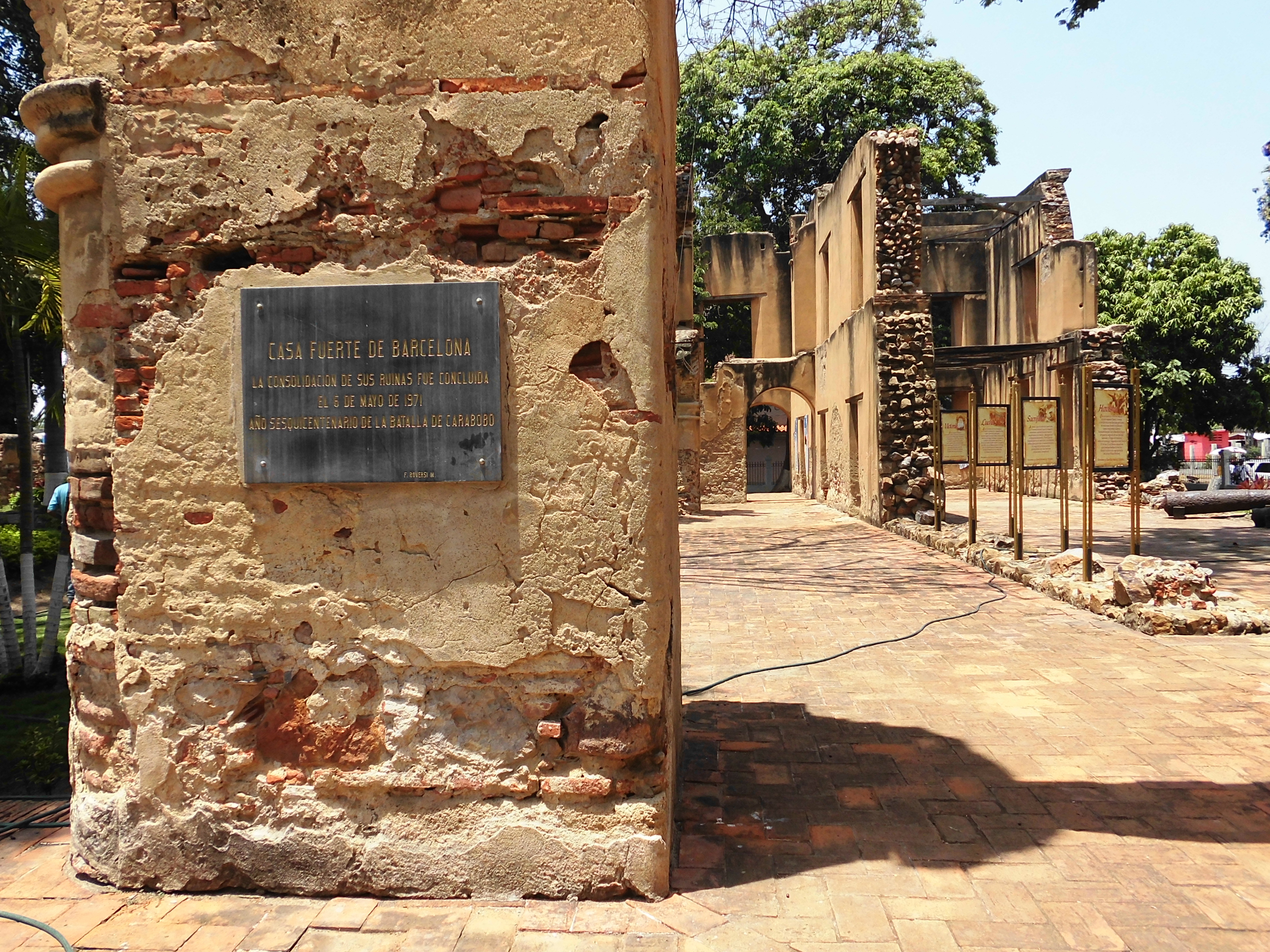
Fortified structures from the same era, notably the Monumento Casa Fuerte, point to a period when the city needed physical defences, while the Puente Real de los Españoles recalls the infrastructure the Spanish crown built to connect and control its colonial territory.
The independence era left its own mark on the city, most visibly in the statues of Simón Bolívar, Francisco de Miranda and Simón Rodríguez, as well as the joint monument to Bolívar and José Francisco Bermúdez. These figures, central to Venezuela's break from Spanish rule, are commemorated across the city's plazas rather than confined to a single museum or monument.
More recent history is represented by the Escultura de Hugo Chávez, a landmark referencing Venezuela's modern political era, alongside civic and cultural institutions such as the Ateneo Miguel Otero Silva, named for a twentieth-century Venezuelan writer, journalist and public figure. Ruins such as the Ruinas taller del ferrocarril speak to the industrial era of railway building, while the Ruinas Iglesia Santa Lourdes shows how some structures from more recent centuries have been left as remnants rather than restored.


Good to know
Barcelona is the seat of the Municipio Simón Bolívar in Venezuela's Anzoátegui state, with a population of 815,141 across an area of 706 km2. Spanish is the language spoken throughout, the currency is the Venezuelan bolívar (VES), and the city runs on the America/Caracas time zone.
None of Barcelona's attractions carry UNESCO World Heritage status, and the city's appeal rests instead on the accumulation of its churches, monuments, plazas and museums rather than any single landmark. Local official information is available through the Alcaldía Simón Bolívar's website.


Nearby places
Journeys through here
Common questions
- Is this Barcelona the same as the one in Spain?
- No. This Barcelona is a city in eastern Venezuela, capital of the Municipio Simón Bolívar in Anzoátegui state, entirely separate from the better-known Barcelona in Catalonia, Spain.
- What are the main things to see in the city itself?
- The historic centre, Casco Central, holds the Catedral San Cristóbal de Barcelona, the Casa Arzobispal and several monuments and plazas, including Plaza Libertadores with its statue of Simón Bolívar. The Paseo Río Neverí and its adjoining parks offer a greener, riverside alternative to the old town's churches and squares.
- Can Barcelona be used as a base for day trips?
- Yes. Nearby Lecherías (5.9 km) and Puerto La Cruz (10.3 km) are very close, while Puerto Píritu, Cumaná, Anaco, Cantaura, Punta de Piedras and Zaraza offer longer day-trip options ranging up to around 112 km away.
- Does Barcelona have any UNESCO World Heritage sites?
- No. None of the attractions in Barcelona hold UNESCO World Heritage status; the city's interest lies in its collection of churches, monuments, museums and plazas rather than any internationally listed site.
Sources & method
- GeoNames — population · retrieved 2026-08-14
- OurAirports (derived) — nearestAirports · retrieved 2026-08-14
- Imagery — commons, openverse
Data compiled 2026-08-14 · editorial checks: passed. See our methodology for how Head Your Way sources and reviews travel data.